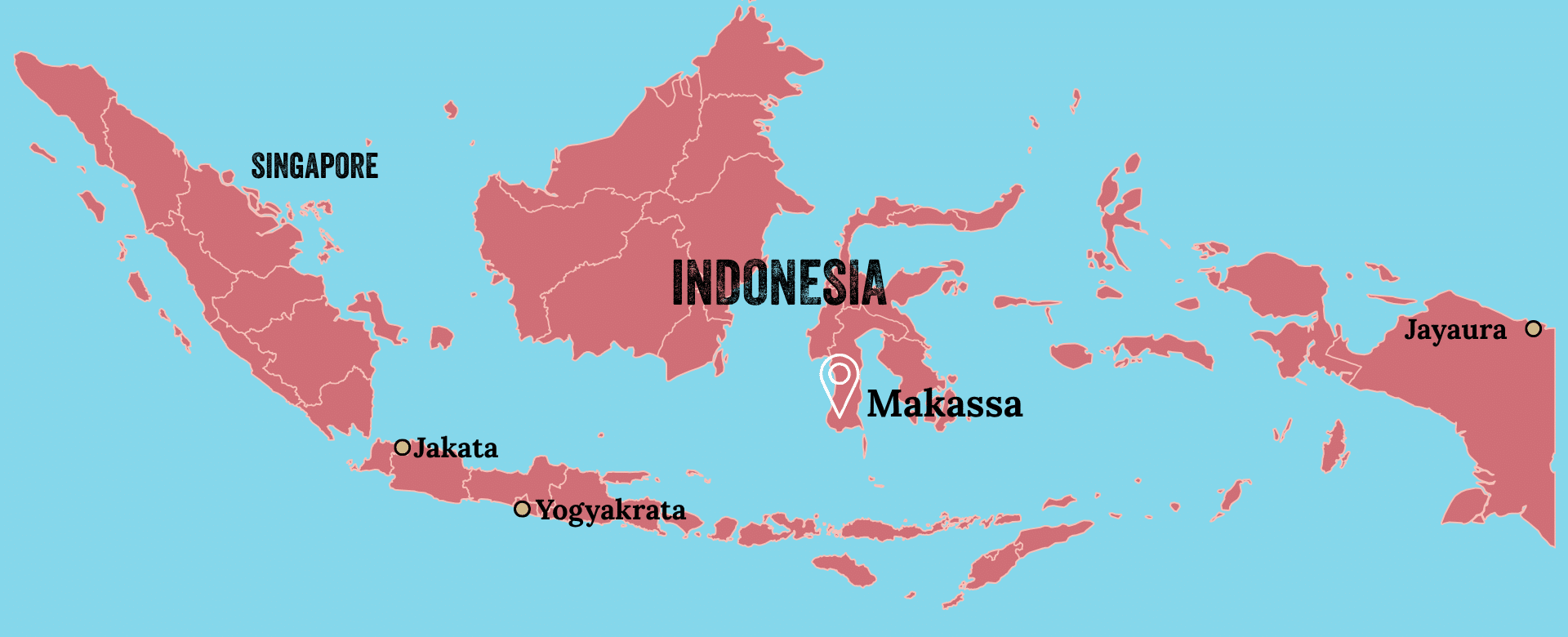
In February I had the opportunity to travel to Indonesia, to meet our program partner Yayasan Cita Wadah Swadaya (YCWS) and visit the Community Led Early Action and Resilience (CLEAR) program, which is implemented by local organisation, INANTA in Makassar, South Sulawesi.
Click to enlarge
Makassar experiences high rainfall, rapid sea level rise and is a mostly low-lying region. These combined risks mean it is extremely prone to flooding. With widespread poverty, the impacts of climate-related disasters are enormous.
The CLEAR program helps communities prepare for disasters and ensure they can respond and recover effectively.
The program achieves this by working in the community to make sure every resident knows how to prepare for and respond to the reoccurring floods – sharing early warnings, helping with evacuation and providing emergency financial assistance so vulnerable community members are supported to evacuate safely and meet their daily needs during floods.
CLEAR also supports the community to access alternative livelihoods so community members have reliable sources of income to meet their families’ needs.
But what does this really mean? And how does it transform lives?
Let me show you!
Scroll down
During our visit to a local community in Makassar, we learned directly from residents how the flooding is severely impacting their lives.
Scroll down
The team explained how the early warning systems alert community members to rising flood water
The relentless nature of floods in the region is overwhelming. But the community-wide impact of the CLEAR program is remarkable.
Every person we met, told a story of how the program has made a huge difference – either in their own personal life, or throughout their community.
Community member, Sanneng (pictured), showed us how high the flood waters rise outside her home.
Little did we know, these streets would be underwater just days after we returned home.
Adifa (pictured below with her daughter) is the head of her household and provides for her teenage daughter. She has always struggled to meet their daily needs and every wet season her home is impacted by flooding.
Joel Pratley/Act for Peace
“When there is a flood, we do not earn anything.”
“We feel ashamed. We are ashamed to go ask others for help because we are poor.”
~Adifa
She has a small business selling vegetables and through CLEAR, she received support to grow her business, increase the quantity and variety of goods she sells and improve her income.
Adifa selling her vegetables
“With that assistance, I was able to slowly turn it around little by little until it became like this.”
“Before, I only sold chilies, tomatoes, and leafy vegetables. Now I can buy onions, buy sago, buy other mixed ingredients as well.”
“So from my sales I can save a little at a time, and I can also give my child some money for groceries.”
Joel Pratley/Act for PeaceAdifa balancing her books after learning financial skills through the program.
One of the ways the program is achieving sustainable, community-led change, is through establishing local disaster committees (known as Kampung Siaga Bencanas – KSBs), which function as community-level drivers of preparedness and resilience. These groups are made up of trained community members who coordinate preparedness activities, mobilise residents and communities and serve as the first point of coordination during flood risks and emergencies.
A KSB committee member checks the river level.
Community disaster committees regularly run training and drills, testing emergency equipment like life jackets, stretchers, radios and first aid kits so they are ready to respond.
Women’s enterprise groups have also received support and training to grow small businesses so they can work together in a collective to produce and sell products. This means entire families have access to sustainable incomes that can sustain them through regular floods.
The group produces chips which they package and sell in their community.
The most rewarding part of this visit was seeing the comprehensive, community-wide impact of the program that is realised because of the locally led approach.
We support our Indonesian partner to deliver this program through a local organisation who is based in Makassar.
Transformation is taking place because leadership is centred locally – from the local governments, municipalities and even village leaders who support the program, to the volunteers who are so passionate about seeing change in their communities that they give their time to help their own community members prepare and respond to disasters.
Act for Peace gratefully acknowledges the support of the Australian Government through the Australian NGO Cooperation Program (ANCP).
Image credits: all images Joel Pratley/Act for Peace
This change wouldn’t be possible without our generous supporters. Because of your support, communities in Makassar are becoming more resilient to the impacts of frequent flooding.
Thank you for helping to create a world where everyone belongs, – Aimée Keay, Communications Manager.
Joel Pratley/Act for PeaceThis locally led program is creating change for participants like Nandi (pictured) who receive cash support to help them survive flood disasters.